Damaged drywall bothers you every time you walk past it. A doorknob hole, a crack above a window, a patch that never quite matched, a ceiling stain after a leak. Each is a small thing, and together they make a room feel unfinished. Fixing them well is a skill, because drywall repair shows when it is done badly.
Purpose Repairs & Painting repairs drywall across Sumner, Robertson and Davidson Counties. We handle everything from nail holes to large cut-outs, and we finish the job properly: texture matched, primed and painted so the repair vanishes.
Repairs we handle every week
Most calls fall into a handful of categories, and each needs a different method. Small holes and dents are filled and feathered. Medium holes get a backer and patch. Large holes and damaged sections get cut out and replaced with new board. Cracks are opened, taped and refinished so they do not return.
Seam cracks and corner bead damage are common in homes that have settled, and we address the cause where possible, such as loose fasteners or poorly taped seams, instead of simply covering the crack.
- Doorknob, anchor and nail holes
- Cracks at corners, doors and windows
- Dents and impact damage
- Water-damaged walls and ceilings
- Damaged corner bead and trim edges
- Holes cut for plumbing or electrical access
Water damage and stained ceilings
A stain means moisture reached the drywall. The first step is making sure the leak is fixed. Once the source is dry and resolved, we remove soft or sagging board, replace it, finish the joints and apply stain-blocking primer. Regular paint will not stop a stain from bleeding through, and that is why water spots reappear after a quick touch-up.
If you are not sure whether the leak is fixed, tell us. We will not seal wet drywall behind new finishes.
Texture matching
The finish texture is what makes a patch obvious or invisible. Homes in this region have knockdown, orange peel, skip trowel, popcorn and smooth finishes, sometimes mixed within the same house. We match what is there using the right tools and compound, and test on a sample when needed.
When a perfect match is not practical, such as an old heavy texture, we discuss alternatives like skimming a whole wall or ceiling so it looks consistent rather than patched.
Primer and paint complete the repair
A repair is not finished until it is primed and painted. Fresh joint compound absorbs paint differently than old drywall, and unprimed patches show as dull spots. We prime every repair and paint the affected wall or the whole room so the color is uniform.
Because painting is part of what we do, you do not need to find a separate painter or hope the colors line up.
Pricing and what to expect
Estimates are free. Small repairs are often quoted by the job or by the number of patches, while larger projects are priced after a walk-through. We explain what the repair will involve, how many visits it needs and how long compound has to dry between coats.
When a repair is really a symptom
Not every crack is cosmetic. A crack that returns after repair may point to settling, a loose framing member, a poorly taped seam or humidity swings. Repeated stains point to a leak that has not been solved. We look for the pattern before we patch, because the cheapest repair is the one you only do once.
If something looks like it needs a plumber, roofer or engineer, we tell you plainly. Our job is to repair the wall properly once the underlying problem is dealt with.
What to do before we arrive
Clear the area around the damage so we can work, and tell us whether the problem has been getting worse. If water is involved, make sure the source has been repaired and photograph the stain so we can compare. If you have leftover wall paint, keep the can and note the sheen. It makes color matching easier.
Photos sent ahead of the visit help us bring the right materials, but the free estimate is done in person so we can feel the wall and check around the damage.
Ceiling holes and accident repairs
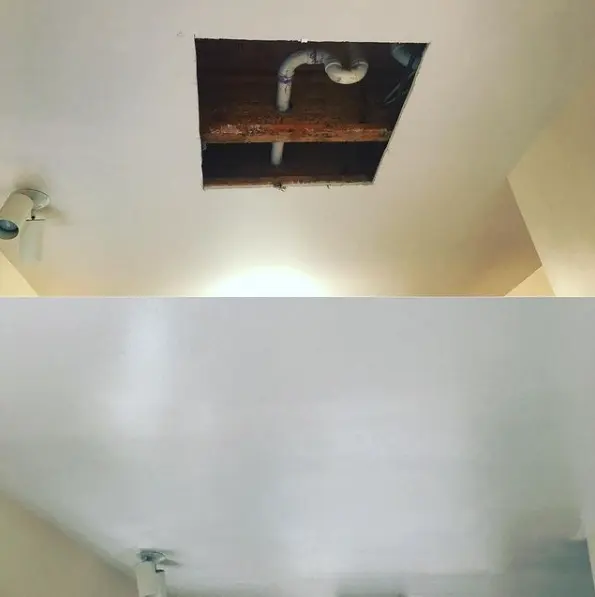
Ceiling damage is one of the most common calls we get, and reviews reflect it: a hole in the ceiling fixed so cleanly it is hard to see, a ceiling repaired and repainted after a junk-removal mishap, a ceiling repaired in late 2024 that the owner later recommended to family. The method is the same each time: cut back to sound board, patch and tape, finish, texture to match, prime and paint the whole ceiling so there is no visible edge.
How a drywall repair goes
Diagnose
We find the cause of the damage and check whether anything behind the wall needs attention.
Cut and patch
Damaged areas are cut out, backed and patched with new board.
Finish and texture
Seams are taped and coated, sanded smooth and textured to match.
Prime and paint
Repairs are primed and painted so they blend into the surrounding wall.
Where we do drywall repair
We take on drywall repair projects across Sumner, Robertson, and Davidson Counties. Pick your city to see how this work applies to the homes and neighborhoods there.
Drywall Repair questions, answered
Can you repair a large hole in drywall?
Yes. Large holes are cut out and replaced with new board, taped, finished, textured and painted.
Why does my crack keep coming back?
Cracks often reopen because of movement, loose fasteners or poorly taped seams. We address the cause where possible and use tape and compound designed to hold.
Will you match my existing texture?
In most cases, yes. We match common textures and discuss alternatives when an exact match is not practical.
Do you fix ceiling water stains?
Yes, once the leak is repaired. We replace damaged board and use stain-blocking primer before paint.
Do you paint after repairs?
Yes. We prime and paint the repair so it blends into the wall.